Marathon Gel Timing: How To Fuel For Peak Performance On Race Day
You've carb-loaded, tested your breakfast, sorted a carb-electrolyte drink mix for hydration, and picked out a gel flavour you actually enjoy. But there's one more variable that decides whether your fuelling plan works or backfires on race day: timing. Taking the right gels at the wrong time can leave you with stomach cramps at the 30km mark or reaching for on-course gels you haven't tested in training. Here's how gel timing actually works, how to calculate your own plan, and which gels suit which kind of runner.
Table Of Contents
-
Why Does Gel Timing Actually Matter?
-
How Do I Calculate My Gel Timing For Race Day?
-
What Does A Marathon Gel Timing Plan Actually Look Like?
-
Which Gel Should You Choose?
-
Take Home Points
Why Does Gel Timing Actually Matter?
Your muscles store a limited supply of glycogen - enough to fuel roughly 90-120 minutes of running at marathon effort, even with a full carb-load behind you. Once that runs low, pace drops fast unless you're topping up from an outside source ¹. That's the whole point of race-day gels: they're not a reward for feeling tired, they're a way of keeping your glycogen tank from ever running low in the first place.
The catch is that your gut can only absorb carbohydrates at a certain rate, and that rate depends on both the gel and how well-trained your gut is ². If you wait until you feel fatigued to take your first gel, you're already behind - a gel taken in response to fatigue is playing catch-up rather than preventing it. This is why the Aid Station race-day guide is emphatic that runners should take their first gel or carb source at a pre-planned time, not wait for fatigue to set in - by the time you feel low, the deficit has already started.
Get the timing wrong the other way - too much, too soon - and you may risk the opposite problem: gastrointestinal distress, bloating or a gel that sits heavy because your gut hasn't been trained to handle that rate of intake ³. Good gel timing is really a balancing act between two curves: how fast your glycogen is being used up, and how fast your gut can realistically absorb replacement fuel.
Talk Nerdy To Me
It takes roughly 15-20 minutes for the carbohydrate in a gel to be digested and start reaching your bloodstream. That lag is exactly why "take a gel when you feel tired" is not ideal as a strategy - by the time you feel the dip, you're 15-20 minutes away from any relief even if you fuel immediately. Planning your gels on the clock, not on how you feel, closes that gap.
How Do I Calculate My Gel Timing For Race Day?
You don't need a spreadsheet, but a bit of maths goes a long way:
-
Start with your target carbohydrate rate → Sports nutrition guidelines generally recommend 30-60g of carbohydrate per hour for efforts lasting 1-2.5 hours, stepping up towards 60-90g per hour for anything beyond that ⁴. Well gut-trained runners can push higher still - one study had elite runners tolerating 120g per hour across a marathon-distance trail race with no added GI cost ⁵.
-
Convert grams into gels → Most standard gels carry 22-30g of carbohydrate; high carb gels can carry 40-50g, and some drink mixes stretch to 80-120g. Divide your hourly target by your gel's carbohydrate content to get gels per hour.
-
Spread it out, don't dump it → Splitting your hourly target across two smaller doses (e.g. every 20-30 minutes) keeps blood glucose steadier than taking it all in one hit, and is gentler on the gut.
-
Front-load slightly → Because gels take several minutes to digest, plan your first dose early in the race - before you need it - rather than at the first sign of fatigue. Proactive, scheduled fuelling consistently outperforms reactive fuelling ⁶.
-
Rehearse it → Practise your exact gel schedule on long training runs. This is how you gut-train: repeated exposure to carbohydrate during exercise measurably improves your gut's tolerance and absorption over time, which is what allows the jump from a comfortable 60g/hour to a trained 90-120g/hour³˒⁵
Talk Nerdy To Me
Why do "multiple transportable carb" gels (glucose + fructose blends) let you absorb more than a single-source glucose gel? Your gut absorbs glucose via a transporter called SGLT1, which saturates at around 60g/hour (roughly 1g per minute) no matter how much more glucose you throw at it. Fructose, however, uses a completely separate transporter (GLUT5). Combine the two, and you're using two absorption pathways at once instead of one - which is how blended gels push the practical ceiling from ~60g/hour up toward 90g/hour or more ².
What Does A Marathon Gel Timing Plan Actually Look Like?
Here's an example structure similar to the one in our Marathon Preparation Guide & Checklist - adjust gel count to your own carbohydrate target and gut tolerance.
-
20-30 minutes before the start → 1x 30g energy gel. Your muscle glycogen is already topped up from carb-loading, so this dose isn't about storage - it's about having glucose immediately available in your bloodstream the moment the gun goes off. Choose a caffeinated option if that sits well with you such as Maurten Gel 100 Caf 100 OR Styrkr Gel30Dual-Carb Energy Gel- Caffeine+
-
0-1 hour into the race → 1x 30g energy gel such as Precision Fuel & Hydration PF 30 Energy Gel, PURE Sports Nutrition Fluid Energy Gels OR PILLAR Performance Gel 30.
Glycogen stores are still high here, but starting your gut on fuel early - rather than waiting - keeps absorption ticking over and is useful insurance in hot conditions or at a faster-than-usual pace.
-
1-2 hours into the race → 1-2 energy gels. This is where the 30-60g/hour target really kicks in, as glycogen reserves start to matter more. To reduce how many gels you need to carry you may want to opt for a higher carb gel such as SAP Good Energy Gel 40g OR Enervit C2:1Pro Carbo Gel.
-
2-3 hours into the race → 1-2 energy gels. If you know from training that you tend to fatigue around this time, this is a good window for a caffeinated option, more on why below.
-
3-4 hours into the race → 1-2 energy gels, maintaining the same rate to hold pace through to the finish.
Note: Stop fuelling around 20 minutes before the finish line. At that point there's no realistic window left for a gel to digest and contribute anything useful, and cutting fuelling here reduces late-race GI risk when your gut is least able to handle it.
Which Gel Should You Choose
Popular Gels for First-Time Marathon Runners
For runners who want a simple, well-tolerated option they don't need to overthink - race-tested formulas designed to sit easily on the stomach, with straightforward carb content that's easy to plan around.
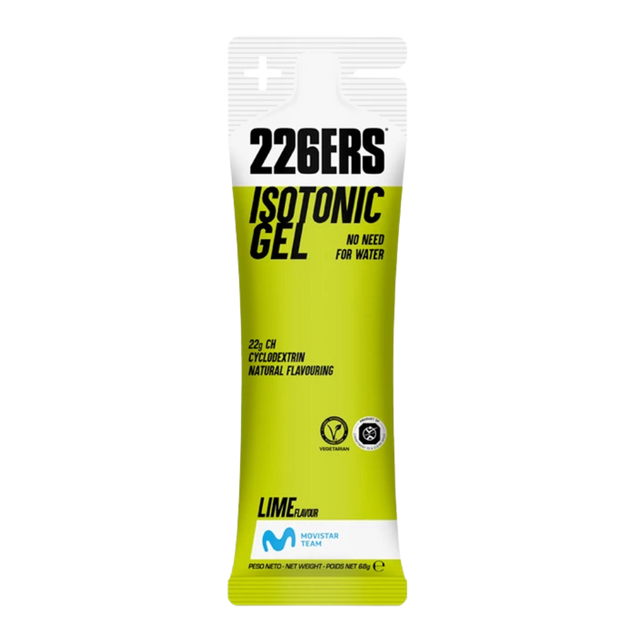
Look at → SIS GO Isotonic Energy Gel, 226ERS Isotonic Energy Gel, PURE Sports Nutrition Fluid Energy Gel.
Popular Gels for Sub-3 Runners
For runners racing at a higher intensity, where blood flow is diverted away from the gut and glycogen burns faster - these runners benefit from higher-carb, low-osmolality options (hydrogel or glucose:fructose blends) that pack more fuel per gel without adding GI risk, and that have been proven at elite race pace.
Look at → Maurten Gel 100, SIS Beta Fuel Energy Gel, Precision Fuel & Hydration- PF30 Energy Gel.
For runners who prefer whole-food, minimally processed ingredients - think maple syrup, tapioca syrup, honey and fruit - over lab-formulated maltodextrin blends.
Look at → Maple Movement, SAP, Nectar Sport, Untapped, Honey Stinger, Sunday Salt, Lecka
For runners who've already tested caffeine in training and know how their body responds - caffeine is best used strategically rather than throughout the race. Position-stand guidance places the effective performance-boosting dose at roughly 3-6mg/kg of bodyweight, and there's good reason to save it for either 20-30 minutes before the start or the 2-3 hour mark, when it does the most for you, rather than front-loading it early and risking tolerance, jitters or GI upset before you actually need the lift ⁷.
Look at → Maurten (Gel 100 CAF 100), Precision Fuel & Hydration PF 30 Caffeine Gel, SIS (Beta Fuel + Caffeine).
Take Home Points
- Glycogen stores only last 90-120 minutes at marathon effort - gels exist to stop that clock running out, not to fix it once it has.
- Take your first gel at a planned time, not when you first feel tired - by then, you're already behind.
- Target roughly 30-60g of carbohydrate per hour for the first 1-2.5 hours, stepping up to 60-90g+ per hour beyond that, split into smaller, more frequent doses.
- Practise your exact plan in training to gut-train your tolerance for higher carb rates.
- Save caffeinated gels for when fatigue typically hits - usually 2-3 hours in or the final stretch - rather than the start line.
-
Stop fuelling about 20 minutes before the finish.
Ash Miller
Dietitian and Nutritionist (Masters)
Bachelor of Physical and Health Education
Instagram: @ashthomo_nutrition
References
-
Hargreaves M, Spriet LL. Muscle glycogen stores and fatigue. J Physiol. 2013;591(18):4405-4413.
-
Jeukendrup AE, McLaughlin J. Carbohydrate ingestion during exercise: effects on performance, training adaptations and trainability of the gut. Nestlé Nutr Inst Workshop Ser. 2011;69:1-17.
-
Jeukendrup AE. Training the gut for athletes. Sports Med. 2017;47(Suppl 1):101-110.
-
Thomas DT, Erdman KA, Burke LM. American College of Sports Medicine joint position statement: nutrition and athletic performance. Med Sci Sports Exerc. 2016;48(3):543-568.
-
Viribay A, Arribalzaga S, Mielgo-Ayuso J, Castañeda-Babarro A, Seco-Calvo J, Urdampilleta A. Effects of 120 g/h of carbohydrates intake during a mountain marathon on exercise-induced muscle damage in elite runners. Nutrients. 2020;12(5):1367. doi:10.3390/nu12051367
-
Kerksick CM, Arent S, Schoenfeld BJ, Stout JR, Campbell B, Wilborn CD, et al. International society of sports nutrition position stand: nutrient timing. J Int Soc Sports Nutr. 2017;14:33. doi:10.1186/s12970-017-0189-4
-
Guest NS, VanDusseldorp TA, Nelson MT, Grgic J, Schoenfeld BJ, Jenkins NDM, et al. International society of sports nutrition position stand: caffeine and exercise performance. J Int Soc Sports Nutr. 2021;18(1):1. doi:10.1186/s12970-020-00383-4
Disclaimer:
The content in this article is for general information only and is not a substitute for professional medical advice, diagnosis, or treatment. Always speak with your doctor or allied health team before changing your diet, exercise, or taking supplements, especially if you have a health condition or take medication. Please use this information as a guide only. Aid Station doesn't take responsibility for individual outcomes.